
As summer arrives, many houses in Hackensack, NJ, seek help for their AC repair. Most commonly, there are five problems, and you must understand what they are and how to fix them.
- Bad Capacitor
By far the most common AC repair problem, a bad capacitor is behind more AC repair calls in Hackensack, NJ than almost anything else.
The symptoms of a bad capacitor are usually pretty easy to spot. The fan inside the house is going to be running, but it’s going to be blowing hot air or basically room temperature air. The unit outside will not be running at all. Every 30 seconds or so, there might be a buzz, like the air conditioner is trying to start, but it fails to start.

AC Repair in Hackensack, NJ
What often happens is that everything is working great, but the house is not getting cooled off. The two fans are working, but the compressor is not because the capacitor is dead. Once the capacitor is replaced, everything fires right up.
- Low Refrigerant
The second reason why an air conditioner stops working right is that it is low on refrigerant. Unfortunately, this problem is a little harder to deal with and most likely an AC service technician will need to come out to get that fixed.
It might be dirty. Maybe after washing it down, that might just be all it needed. Or if the furnace filter hasn’t been replaced in a long time, try replacing the filter and see if that makes a difference.
If that doesn’t help, there’s one easy test to confirm whether it’s not cooling enough: measuring the temperatures in the ductwork by the furnace. A probe thermometer works for this, as long as it can be inserted into the ductwork.
If the temperature difference is below 15 degrees, say it’s 10 degrees or even 8 degrees, that means something is wrong. Either the airflow is restricted, or the unit is low on refrigerant, and that is why it’s not cooling down enough.
- Plugged Condensate Drain
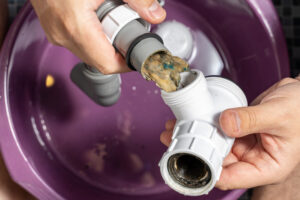
Usually, it’s simply because either the hose, the condensate drain line, or the PVC pipe is plugged, or the fitting where it comes into the A coil is plugged up with bugs or dirt or leaves. All that needs to happen is clearing that out and the leaking problem should go away.
When it’s PVC, it’s usually all glued. Options are either to cut it somewhere and then use a coupler to put it back together, or an even easier method is to simply get some compressed air and blow backwards inside the pipe. If there’s anything stuck, usually whatever is stuck is going to be right at the fitting. Blowing it backwards will push the blockage through and a bunch of water will come gushing out.
- Bad Control Board
The symptoms of a bad control board vary, but usually the furnace or the air conditioner is going to start doing some really weird stuff.
For example, the control board can turn on both the furnace and AC at the same time, sending power to both of them. Both of them running at the same time doesn’t get much accomplished.
Or there can be a situation where the control board does not send power to the fan motor inside. The unit outside will be running just fine, but the fan inside is not getting any power. What happens then is everything freezes up. The A coil on top of the furnace will freeze up first. Sometimes it can turn into just a solid block of ice.
- Bad Condenser Fan Motor
This one is pretty obvious. The fan inside is running. The compressor usually will be running until it overheats, but the condenser fan motor on top of the unit will not be running.
If the AC runs for a couple of minutes without the fan running, going outside might reveal some smoke or steam coming up from the unit.
It is possible, though, that the fan motor is good and it’s simply the capacitor that is dead and that’s why that fan motor is not coming on. So before condemning a fan motor, the capacitor should be checked first.
It might run just fine for the rest of the year. To do that, all that’s needed is a long stick or a long screwdriver, or even a drill bit extension. Reaching in between the grates and giving the fan blade a push just to get it going while the unit is running is all it takes..
Frequently Asked Questions
What are the signs of a bad AC capacitor in a Hackensack NJ home?
The fan inside the house is going to be running, but it’s going to be blowing hot air or basically room temperature air. And the unit outside will not be running at all. Every 30 seconds or so, there might be a buzz, like the air conditioner is trying to start, but it fails to start.
How can a homeowner test if an AC is low on refrigerant?
There’s one easy test: measuring the temperatures in the ductwork by the furnace. The temperature difference between the supply and the return, on a normally working air conditioner, should be somewhere between 15 and 20 degrees. If it’s below that, let’s say it’s 10 degrees or even 8 degrees difference, that means something is wrong.
What causes water to pool under the furnace during AC operation?
Usually, it’s simply because either the hose, the condensate drain line, or the PVC pipe is plugged, or the fitting where it comes into the A coil is plugged up with bugs or dirt or leaves. All that needs to happen is clearing that out and the leaking problem should go away.
Why would an AC unit freeze up?
If the control board does not send power to the fan motor inside, the unit outside will be running just fine, but the fan inside is not getting any power. What happens then is everything freezes up. The A coil on top of the furnace will freeze up first. Sometimes it can turn into just a solid block of ice.
What should be checked before replacing a condenser fan motor?
It is possible that the fan motor is good and it’s simply the capacitor that is dead and that’s why the fan motor is not coming on. So before condemning a fan motor, make sure to check the capacitor.