
When a drain backs up, the picture in your head is a plug, something round and solid wedged in the pipe like a cork in a bottle, and the job is to get the cork out.
That is the picture and it is wrong. Almost nothing in a residential drain line works that way.
What Is Actually in There
What is actually in there is a sleeve. Over months and years, everything you send down that pipe leaves a thin film on the wall. Grease, soap, coffee grounds, the starch off pasta water, skin cells, hair, toothpaste, shaving cream.
That film goes rancid and turns into what we call biofilm, which is just a scientific way of saying a living slime layer of bacteria bonded to the pipe.
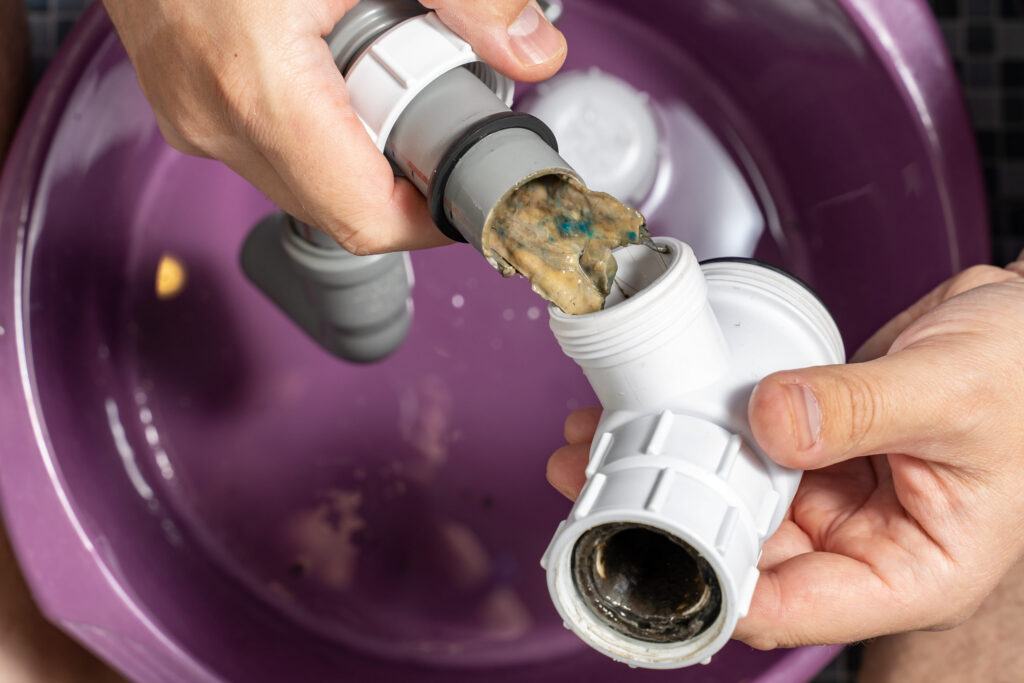
Why Is The Drain Getting Clogged?
It is not sitting loose in the water, it is stuck to the wall like the lint sleeve inside a clothes dryer hose. That sleeve grows inward from all sides.
What a Cable Machine Does
A drain snake is a long steel cable with a cutting head on the end, and it spins down the middle of the pipe. It follows the path of least resistance: the water channel, or the open middle. It hits the blockage and it drills.
Think of coring an apple. You get a clean hole straight through the center and the whole rest of the apple is untouched.
A plunger is even less thorough; it just shoves a slug of water hard enough to dislodge the plug and push it downstream, and the sleeve never gets touched.
A clean pipe wall sheds debris, a biofilm sleeve collects it. That is why the clock resets so fast. You did not start over at 3 years, you started over at 3 weeks of open bore on a pipe wall that is now perfectly built to catch things.
Pattern One: Grease
Pattern one is grease and it is the king of kitchen lines. Cooking grease fools people for a simple reason. When it goes down the drain, it is hot and liquid and it looks exactly like water going down.
It moves like liquid for the first several feet, so your eyes tell you it left the building. It did not leave the building; it cooled. Grease stays liquid while it is warm and it turns solid the second it drops below body temperature.
It flows merrily through the trap under your sink, still hot, and then it reaches the first place the pipe gets cold. Usually that is where the line leaves the heated part of your house, under a slab, out through a crawl space, in the joist bay along an exterior wall, or right at the point where your branch line ties into the main. Cold pipe, warm grease, it plates out on the wall like candle wax running down a candlestick and hardening halfway.
Pattern Two: Hair and Soap Scum
Pattern two lives in your bathroom and it works completely differently. Bathroom lines do not clog from grease, they clog from hair and soap scum working as a team. What happens is a strand of hair hangs up on something: the crossbar in the drain, the pop-up stopper linkage, a rough spot in the trap.
One strand does nothing, but that strand catches the next one, and now you have a little net. Meanwhile, the soap you use is depositing scum, and scum is sticky. It cements the strands together and glues the mat to the pipe wall.
Pattern Three: Galvanized Steel
Pattern three does not have a happy fix. If your house went up before roughly the mid 1960s and nobody has repiped it, your drains may be galvanized steel, which is steel with a protective zinc coating. The zinc wears off from the inside first and the bare steel starts corroding.
Corroded steel does not rust smooth, it rusts into a crusty, pitted interior with the texture of a coral reef, and every pit is a snag point. The scale takes up volume too, so the pipe runs narrower than the day it went in. That matters because everything else assumes a scoured wall ends up slick, but you cannot make corroded steel slick, the roughness is not a coating on the pipe, it is the pipe.
Pattern Four: Tree Roots
Your main sewer line runs under the yard full of warm, nutrient-rich water, which to a tree root system is a buffet. Roots find the tiniest weep at a joint and send in a hair-thin tendril that swells into a mass inside the pipe, and it ends up looking like a bottle brush growing sideways out of the wall.
A snake will cut a channel through a root mass, the water runs and everybody feels good, then the roots keep growing because the tree is alive and the crack is still there, and you are back in 6 to 18 months.